Top use case
Land Analysis: choosing the right spot
Identify the optimal location for your construction project in minutes.
Analyse more sites in less time:
In the race to scale renewables and infrastructure, site screening is often a big bottleneck. Traditional methods rely on fragmented «generic maps» and expensive, time-consuming field visits. Without a unified view of spatial constraints, teams often discover deal-breakers far too late in the development cycle.
The Land Analysis Module provides high-fidelity, decision-grade KPIs and GIS-ready layers. It allows your team to perform rigorous site screening remotely, ensuring you only move forward with projects that meet your specific risk and ROI profiles.
For technical or non-technical users
Collaborative tool
Seamlessly integrable
Automated reporting
Integrated visual & numerical insights
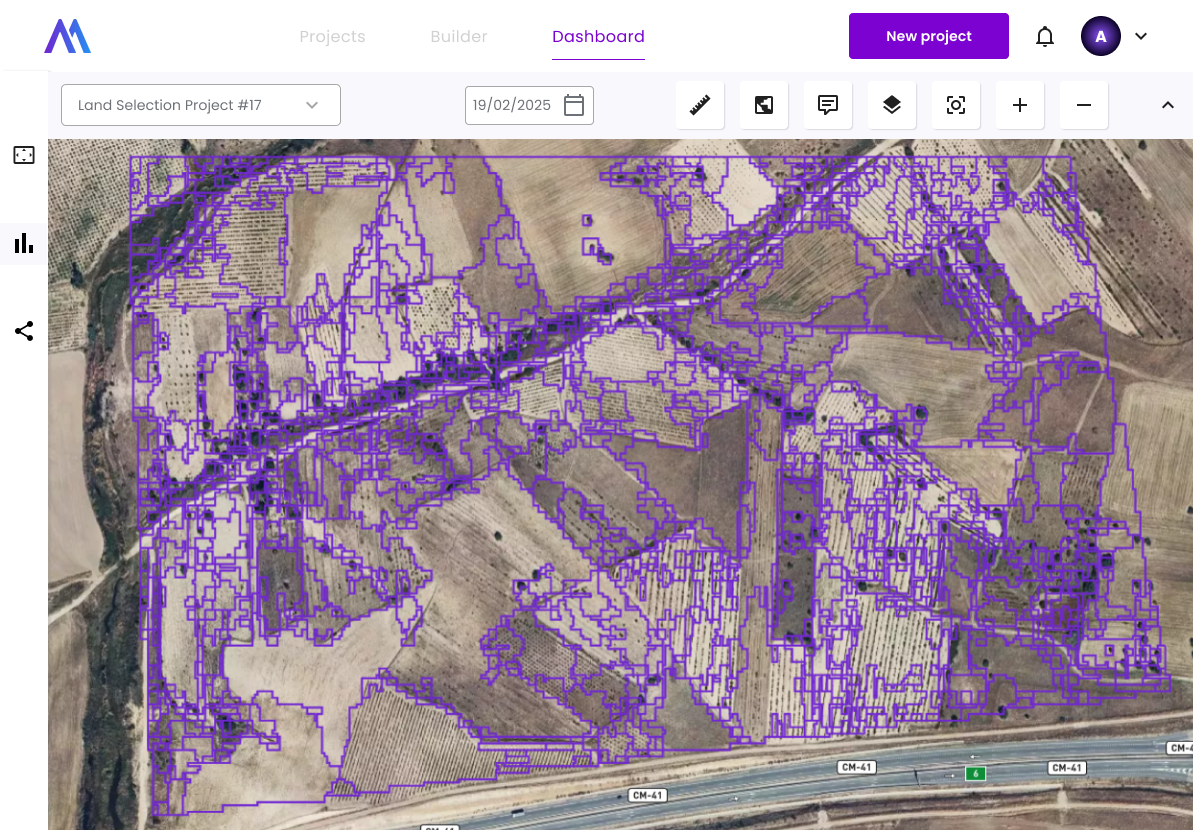
Don’t just see the land; quantify it. Overlay high-resolution imagery with data-driven KPIs —such as slope percentages, solar irradiance, and vegetation state— to transform pixels into a formal business case.
Historical climate analytics
De-risk your project against environmental volatility. Access years of historical climate data to understand precipitation patterns, wind speeds, and temperature fluctuations, ensuring your infrastructure is built for long-term resilience.
Bring your own imagery
Your data shouldn’t live in a silo. Upload and analyze your own drone captures or proprietary aerial surveys. Our engine processes your imagery through our analysis pipeline, allowing you to use our advanced GIS tools on your custom data sets.
On-demand 15cm DTM/DSM tasking
When 30-meter resolution isn’t enough, go granular. Autonomously task «engineering-grade» Digital Terrain Models (DTM) and Digital Surface Models (DSM) at 15cm resolution. This allows for precise earthwork calculations and runoff modeling without sending a surveyor to the field.
Imageryst’s Datasets
Our primary datasets!
Contour Lines
Solar Radiation
Roads
Slope
Vegetation type
Lights
Altitude
Water Bodies
Soil Humidity
Vegetation health
FAQ’s
Quick answers to common questions
How often does the satellite pass or what is the time interval (revisit/latency) between images?
It depends on the satellite. Standard or free satellites pass every 5 days, while paid satellites provide images almost daily.
What is the image precision/resolution?
How much does it cost to use Imageryst?
Imageryst is typically subscription-based, but we also provide ad-hoc solutions. Pricing varies based on the product (Land Analysis Core or Advanced, Work Monitoring, ad-hoc solutions…) and the image area (km²).
What types of companies does Imageryst work with?
We work with medium-sized enterprises (SMEs) and large companies in different sectors, such as energy, utilities and engineering. However, we are very keen on R&D and have no problem tailoring our solutions to your companies’ specific needs.