Top use case
Asset protection
Estimate risks for proactive prevention. Quantify losses. Monitor recovery.
Protect your assets, limit risks
In the race to protect critical infrastructure from escalating environmental hazards, vulnerability assessment is often a major bottleneck. Traditional risk modeling relies on fragmented “historical data” and reactive, manual site inspections that can’t keep pace with a changing climate. Without a unified view of multi-hazard exposure, asset managers often discover fatal vulnerabilities only after a disaster has struck.
Our Asset Resilience Module provides high-fidelity, decision-grade risk KPIs and GIS-ready hazard layers. It allows your team to perform rigorous environmental stress-testing and recovery planning remotely, ensuring you prioritize hardening and response efforts for the assets most critical to your operational continuity and risk profile.
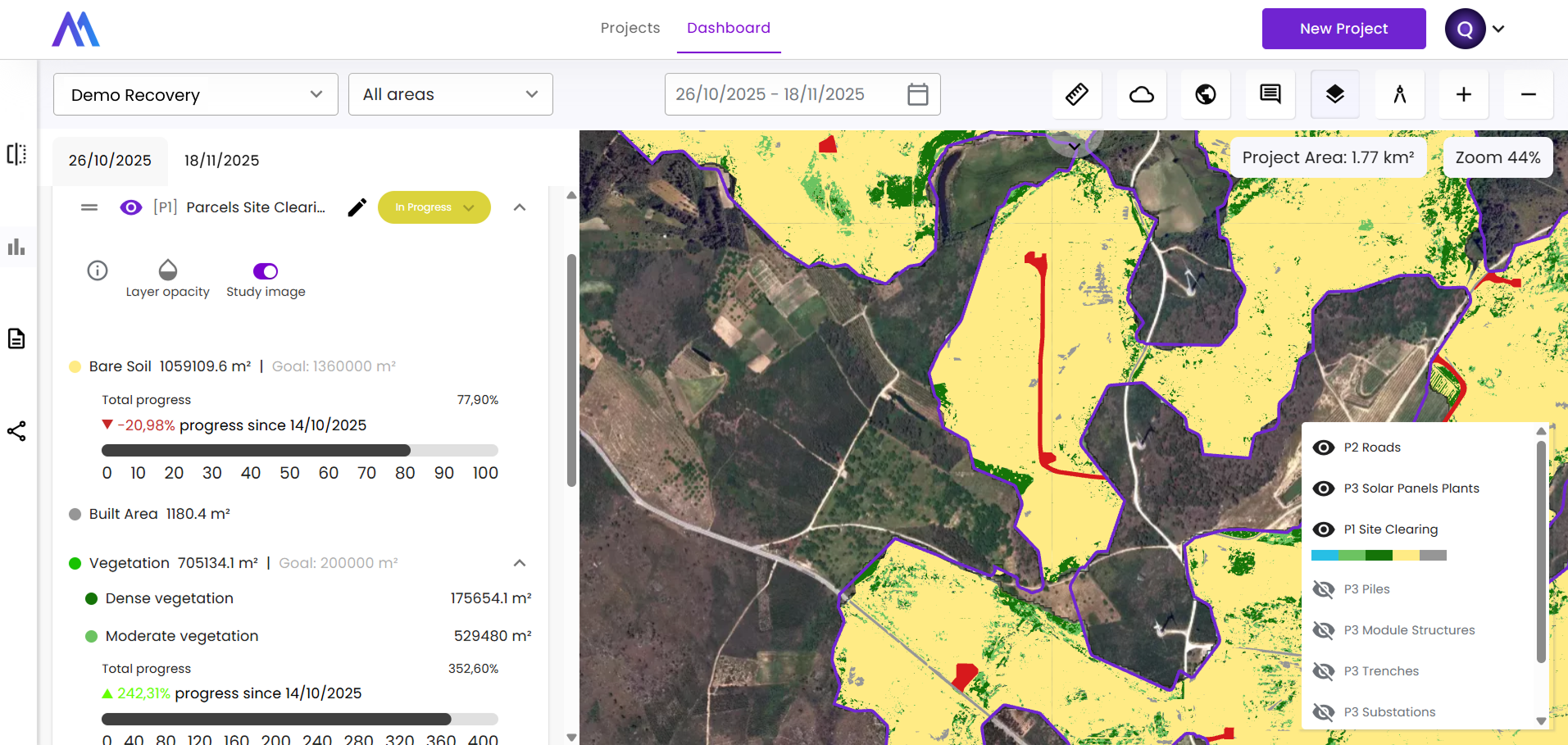
For technical or non-technical users
Collaborative tool
Seamlessly integrable
Automated reporting
Integrated Hazard Insights
Don’t just monitor your assets; stress-test them. Overlay high-resolution imagery with data-driven resilience KPIs: fuel load density, wildfire exposure projections, and structural integrity scores— to transform raw pixels into a prioritized mitigation strategy.
Historical Catastrophe Analytics
De-risk your portfolio against environmental volatility. Access decades of historical hazard data to understand peak gust speeds, flood recurrence intervals, and burn signatures. This ensures your protection protocols are engineered for long-term survival.
Bring Your Own Post-Event Imagery
Your disaster intelligence shouldn’t live in a silo. Upload and analyze your own post-event drone captures or rapid-response aerial surveys. Our engine processes your imagery through our analysis pipeline, allowing you to use our advanced GIS tools to autonomously detect damage on your custom data sets.
On-Demand 15cm DTM/DSM Tasking
When satellite resolution isn’t enough, go granular. Autonomously task 15cm Digital Terrain Models (DTM) and Digital Surface Models (DSM) to identify micro-topography changes. This allows for precise debris volume calculations, erosion monitoring, and hyper-local runoff modeling without putting personnel in harm’s way.
FAQ’s
Quick answers to common questions
How often does the satellite pass or what is the time interval (revisit/latency) between images?
It depends on the satellite. Standard or free satellites pass every 5 days, while paid satellites provide images almost daily.
What is the image precision/resolution?
How much does it cost to use Imageryst?
Imageryst is typically subscription-based, but we also provide ad-hoc solutions. Pricing varies based on the product (Land Analysis Core or Advanced, Work Monitoring, ad-hoc solutions…) and the image area (km²).
What types of companies does Imageryst work with?
We work with medium-sized enterprises (SMEs) and large companies in different sectors, such as energy, utilities and engineering. However, we are very keen on R&D and have no problem tailoring our solutions to your companies’ specific needs.